
India Road Freight Transport Market to Grow from USD 165 Billion in 2025 to USD 401.9 Billion by 2035 at 9.3% CAGR
India Road Freight Transport Market (2026 - 2035)
East India's freight volumes are expanding at the highest regional pace, with steel and mining corridors fueling demand.
Bharatmala Pariyojana highway program, which earmarked over INR 5.35 lakh crore for 34,800 km of economic corridors”
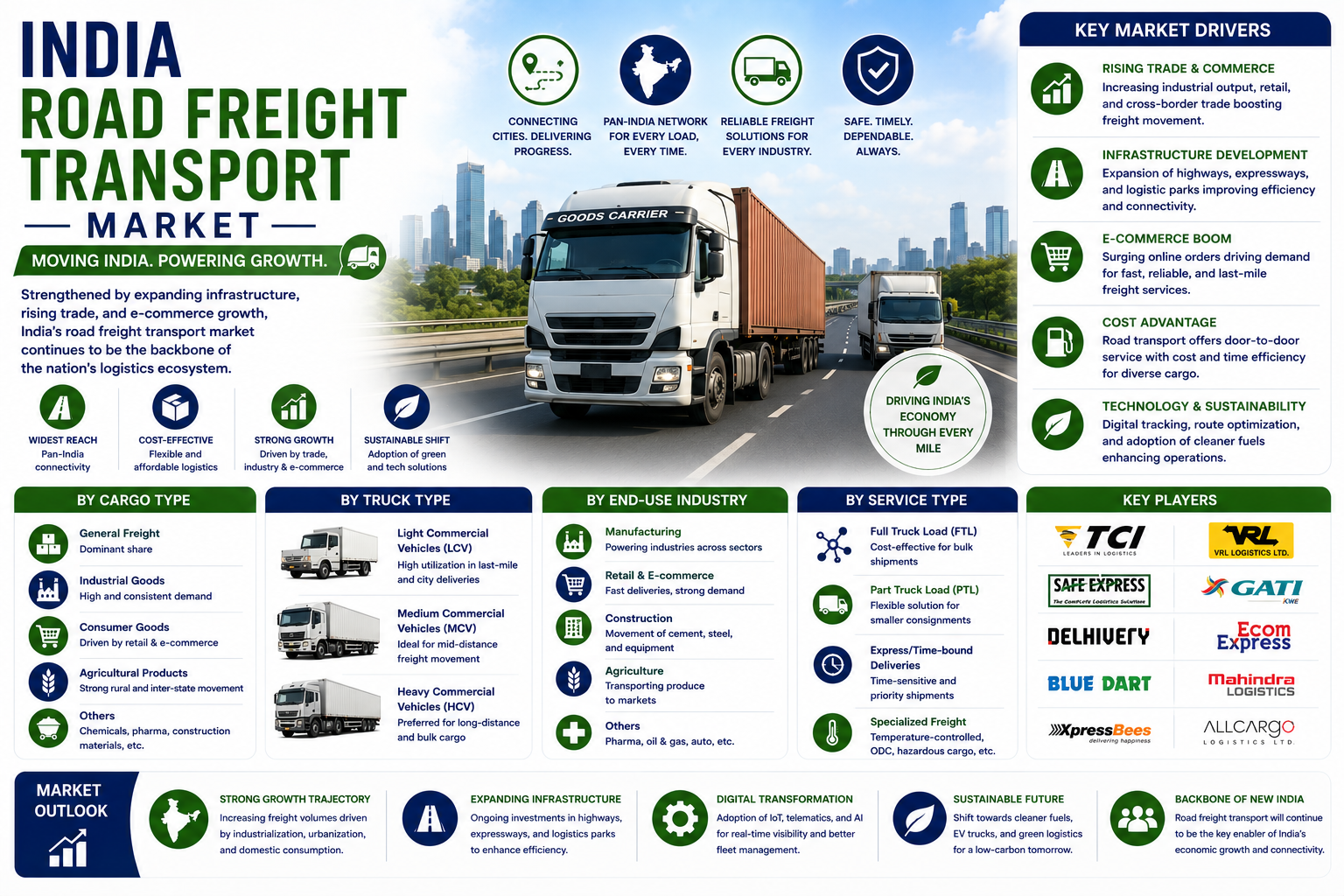
MUMBAI, MAHARASHTRA, INDIA, August 11, 2026 /EINPresswire.com/ -- India's road freight transport market, the backbone of the nation's logistics ecosystem, stood at an estimated $165.0 billion in 2025 and is projected to grow to $180.5 billion by 2026 before surging to approximately $401.9 billion by 2035. This trajectory represents a compound annual growth rate of 9.3% across the forecast period, underpinned by massive infrastructure buildouts, the digitization of a historically fragmented sector, and the relentless expansion of e-commerce and manufacturing activity across the subcontinent.— morth.gov.in
The Infrastructure Catalyst
Two monumental government programs anchor this growth story. The Bharatmala Pariyojana highway initiative has earmarked over INR 5.35 lakh crore for the development of 34,800 kilometers of economic corridors. By March 2026, India's national highway network had expanded from 91,287 kilometers in fiscal year 2014 to 146,572 kilometers, with 22,590 kilometers of Bharatmala roadways already completed. This expansion is critical for reducing transit times, cutting logistics costs, and improving connectivity between manufacturing facilities and national markets.
Simultaneously, the commissioning of the Eastern and Western Dedicated Freight Corridors is reshaping freight flows. While these rail corridors will absorb 15–20% of long-haul bulk cargo, they are simultaneously generating new first-mile and last-mile road feeder volumes as multimodal nodes multiply. Rather than cannibalizing road demand, the Dedicated Freight Corridors are expanding the overall logistics pie by creating more efficient intermodal connections.
Request Free Sample: https://www.marketresearchfuture.com/sample_request/21346
Segment Breakdown: Where the Growth Is
By end-user industry, wholesale and retail trade dominates the market, capturing a 32.6% share in 2025. This reflects the daily replenishment requirements of India's vast fast-moving consumer goods distribution network, serving millions of kirana stores and modern trade outlets. Manufacturing is the fastest-growing end-user segment, forecast to expand at an 11.1% CAGR through 2035, buoyed by Production-Linked Incentive schemes that are concentrating production capacity in dedicated industrial townships and generating predictable, high-volume outbound freight flows. Construction contributed approximately $28.4 billion in 2025, riding the infrastructure capital expenditure cycle. Agriculture is growing at an 8.2% CAGR, supported by mandi bypass reforms and cold chain expansion.
By destination, domestic movements overwhelmingly drive the market, accounting for 67.0% of demand in 2025, reflecting India's continental geography and the primacy of interstate trade. Cross-border international freight, while smaller, is gaining momentum at a 10.0% CAGR through simplified customs procedures at integrated check posts and bilateral motor vehicle agreements, particularly the Bangladesh-Bhutan-India-Nepal Motor Vehicle Agreement.
By truckload specification, full truckload continues to anchor the market on long-haul corridors, valued at approximately $112.7 billion in 2025. However, less-than-truckload is the fastest-growing segment at a 10.9% CAGR, driven by e-commerce parcel density and multi-stop route optimization. Digital freight exchanges have been transformative here, reducing average waiting times at loading points from two to three days to under eight hours on high-density lanes.
By containerization, non-containerized cargo dominates with a 91.2% share, reflecting the prevalence of bulk, breakbulk, and open-body truck operations. Containerized freight is growing at a 9.8% CAGR, fueled by port-hinterland export-import cargo and intermodal growth. By goods configuration, solid goods command a 77.9% share, serving FMCG, building materials, and automotive parts, while fluid goods, encompassing petroleum, chemicals, and edible oils, are expanding at a 10.2% CAGR.
Regional Dynamics: A Multi-Corridor Growth Pattern
West India leads the market with approximately 32% of total revenue in 2025, benefiting from port-hinterland connectivity via Jawaharlal Nehru Port Trust and Mundra, alongside industrial clusters in Maharashtra and Gujarat. Maharashtra alone captures roughly 42% of the regional share through the Mumbai-Pune industrial belt and JNPT port freight. Gujarat is growing at a 9.7% CAGR, supported by Mundra port expansion and chemical and pharmaceutical corridors.
North India holds approximately 28% of the market, anchored by the National Capital Region consumption hub and the Amritsar-Delhi-Kolkata Industrial Corridor. Delhi NCR alone accounts for roughly 38% of the regional share. Uttar Pradesh is expanding at a 10.2% CAGR on the back of expressway network expansion and manufacturing growth. The Punjab-Haryana belt, valued at approximately $9.8 billion, remains critical for agricultural produce freight.
South India contributes roughly 24% of the total market, with Bengaluru's electronics cluster and Chennai's auto-manufacturing belt serving as anchors. Tamil Nadu captures about 36% of the regional share through the Chennai auto hub and Ennore port linkage. Karnataka is growing at a 10.4% CAGR, driven by Bengaluru's tech-driven consumption and aerospace manufacturing. Andhra Pradesh and Telangana contributed approximately $7.6 billion, supported by Pharma City in Hyderabad and Visakhapatnam port activity.
Buy Now: https://www.marketresearchfuture.com/checkout?currency=one_user-USD&report_id=21346
East India is the fastest-growing sub-region, expanding at a 10.8% CAGR. Steel and mining corridors are fueling demand, particularly in Odisha, which is growing at an 11.3% CAGR through steel plant expansion and Paradip port connectivity. West Bengal captures roughly 34% of the regional share through the Kolkata port hinterland. Jharkhand and Bihar contributed approximately $3.1 billion, driven by mining freight and rural connectivity improvements.
Central and Northeast India hold approximately 6% of the market. Madhya Pradesh dominates this cluster with roughly 48% of the regional share through agri-freight and cement manufacturing. Chhattisgarh is growing at a 9.6% CAGR on coal and mineral transport. The Northeast states, valued at approximately $1.4 billion, are emerging as cross-border transit corridors under India's Act East Policy, with highway upgrades linking Guwahati to Myanmar and Bangladesh border posts.
Competitive Landscape
The India road freight transport market exhibits extremely low concentration, with an estimated Herfindahl-Hirschman Index below 500. The top ten organized players collectively control only an estimated 12–18% of total market revenue, while thousands of small fleet owners and individual truck operators command the majority. Consolidation is accelerating as digital platforms aggregate capacity and venture-funded logistics companies acquire regional operators.
Delhivery leads among organized players with an estimated 2.5–3.5% revenue share, operating as a tech-first integrated logistics provider with strong e-commerce alignment. In February 2026, Delhivery reported a 58.4% year-on-year rise in net profit to INR 39.6 crore alongside an 18% revenue increase for the quarter ending December 2025.
Transport Corporation of India holds roughly 2.0–3.0% of the market, leveraging six decades of operational depth across full truckload, less-than-truckload, multimodal, and cold chain services. VRL Logistics captures an estimated 1.8–2.8% share as the largest owned-fleet operator with strong South and West India coverage, operating full truckload, less-than-truckload, parcel, and bus services.
Allcargo Logistics, following its Gati acquisition, holds approximately 1.5–2.5% through express distribution, contract logistics, and third-party logistics integration. Mahindra Logistics accounts for roughly 1.2–2.2% with an asset-light model and parent ecosystem advantages across third-party logistics, last-mile delivery, freight forwarding, and warehousing.
Report Summary: https://www.marketresearchfuture.com/reports/india-road-freight-transport-market-21346
Blue Dart Express, part of the DHL network, captures an estimated 1.0–2.0% through premium air express, ground express, and critical supply chain services. Safexpress holds roughly 1.0–1.8% with an extensive hub-and-spoke surface express network. TVS Supply Chain Solutions accounts for approximately 0.8–1.5%, specializing in automotive and industrial verticals. Rivigo captures roughly 0.8–1.5% with its technology-driven relay trucking model designed to reduce driver fatigue. Ecom Express holds an estimated 0.7–1.2% through deep pin-code penetration for e-commerce last-mile and reverse logistics.
In January 2026, Tata Motors launched 17 next-generation trucks, including expanded electric vehicle options and updated Prima, Signa, and Ultra platforms featuring advanced adaptive safety technology, signaling the OEM community's commitment to modernizing the vehicles that move India's freight.
Related Report
Maritime Freight Transport Market https://www.marketresearchfuture.com/reports/maritime-freight-transport-market-11581
Freight Forwarding Market https://www.marketresearchfuture.com/reports/freight-forwarding-market-two-11579
Freight and Logistics Market https://www.marketresearchfuture.com/reports/freight-and-logistics-market-8698
armenia freight logistic market https://www.marketresearchfuture.com/reports/armenia-freight-logistic-market-34810
Market Research Future
Market Research Future
+1 855-661-4441
email us here
Legal Disclaimer:
EIN Presswire provides this news content "as is" without warranty of any kind. We do not accept any responsibility or liability for the accuracy, content, images, videos, licenses, completeness, legality, or reliability of the information contained in this article. If you have any complaints or copyright issues related to this article, kindly contact the author above.
